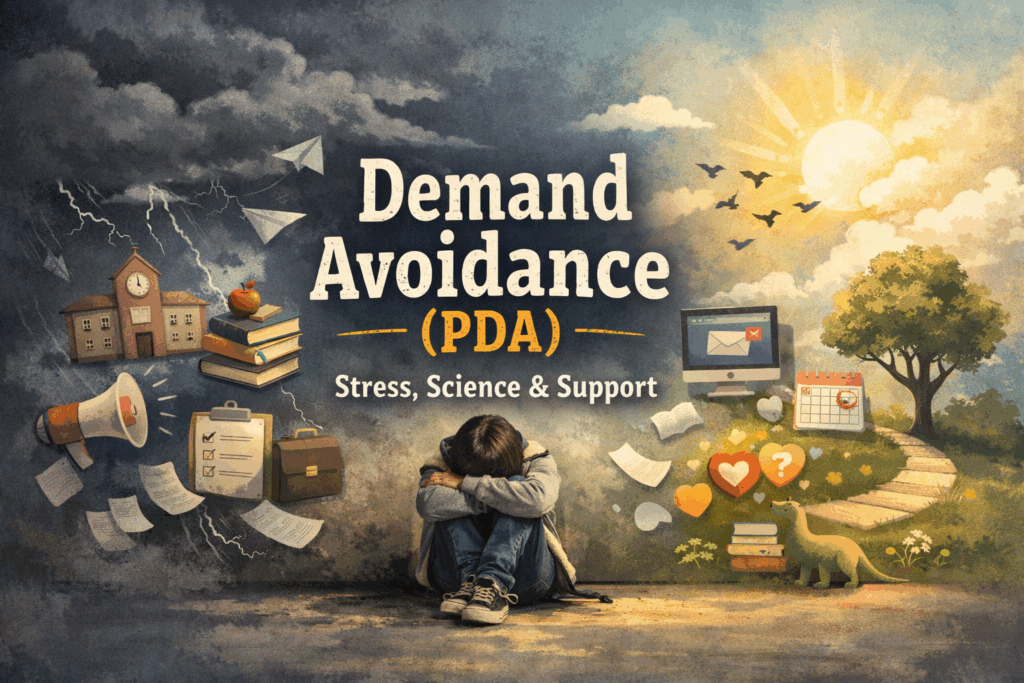
Demand Avoidance, often referred to as PDA, is a term that evokes strong reactions. For some families and adults, it offers relief and recognition. For others, it raises understandable concerns about whether we are over-medicalising behaviour that may be a reasonable response to modern life.
This post aims to offer a balanced, evidence-informed perspective. Not to defend or dismiss the label, but to understand what the research currently tells us, where the uncertainties remain, and how this understanding can guide compassionate and effective support.
What Is Demand Avoidance?
Demand Avoidance describes a pattern in which everyday demands trigger intense distress, avoidance, shutdown, or escalation. These demands may be external, such as school expectations, instructions, or workplace pressures, or internal, such as self-imposed goals or perceived expectations.
Crucially, demand avoidance is not about laziness, defiance, or manipulation. Across clinical observation and research, it is most consistently understood as a nervous system response to perceived threat.
When demands feel overwhelming, uncontrollable, or relentless, the autonomic nervous system may shift into fight, flight, freeze, or avoidance. The behaviour is best understood as communication, not character.
Where the Concept of PDA Came From
The idea of PDA originated in the UK through the clinical work of Elizabeth Newson, who worked extensively with children referred for autism assessments.
Newson observed a group of children whose distress and behavioural patterns did not respond to existing autism frameworks or to traditional behaviour-based interventions. What stood out to her was not simply avoidance, but how that avoidance functioned.
She noted that everyday demands were experienced as deeply threatening, and that escalation tended to occur most sharply when children felt controlled, rushed, or misunderstood. Importantly, she also observed that many of these children appeared socially interested and imaginative, often using humour, negotiation, role-play, or distraction as ways to cope.
At the time, this profile did not sit comfortably with prevailing descriptions of autism, which emphasised social withdrawal and rigidity. Newson argued that viewing these children solely through a compliance-based or behaviourist lens often led to interventions that intensified distress rather than alleviating it.
Her contribution was not simply the proposal of a label, but an insight into motivation. She suggested that these children were not organised around seeking reward, but around avoiding threat – a distinction that remains clinically meaningful today.
What Does “Lack of Identity” Mean?
One of Newson’s most debated observations was her description of a “lack of social identity, pride, or shame.”
Read through a modern lens, this does not suggest emotional emptiness or moral deficit. Instead, it points to difficulty forming a stable sense of self when a child’s internal experience is dominated by anxiety and the need to stay safe.
This may appear as uncertainty about preferences, shifting behaviour across contexts, taking on roles or characters, or relying heavily on external cues to navigate expectations. Rather than indicating pathology, this can be understood as an adaptive response when the nervous system is under chronic pressure.
Seen this way, Newson’s insight can be understood as an early attempt to describe how sustained threat and demand overload may interfere with identity development and emotional regulation.
What Does the Science Actually Say?
When we examine the peer-reviewed research, an important distinction becomes clear. There is broad agreement that the behaviours associated with demand avoidance are real and often associated with significant distress. However, there is not consensus that PDA represents a distinct diagnostic condition.
Systematic and scoping reviews repeatedly highlight methodological limitations, including inconsistent definitions, heavy reliance on parent or caregiver report, limited longitudinal data, and substantial overlap with anxiety, trauma responses, autism, and intolerance of uncertainty.
As a result, Demand Avoidance does not appear as a formal diagnosis in the DSM-5 or the ICD-11.
The evidence therefore supports the existence of a behavioural profile or trait pattern, while remaining cautious about claims of a discrete disorder.
If the Evidence Is Unclear, Why Is PDA Used Clinically in the UK?
This is a fair and important question.
In the UK, many clinicians work within formulation-led models rather than strictly diagnosis-led ones. In practice, practitioners observed that some children described as oppositional, defiant, or non-compliant were not helped by traditional behaviour-based approaches. Reward charts, consequences, and increased structure often escalated distress rather than reducing it.
When clinicians reframed these behaviours as stress and threat responses, rather than wilful non-compliance, they began to use approaches that focused less on control and more on safety and autonomy. These formulations often proved more effective, even as the diagnostic status of PDA itself remained contested.
In this context, PDA has often functioned as a clinical shorthand for a particular way of understanding and supporting distress, rather than as a claim of a clearly defined disorder.
A Personal Concern: Is Demand Avoidance Sometimes Reasonable Push-Back?
Alongside the research, I hold a personal concern that I think is important to name openly.
I wonder whether some behaviours labelled as demand avoidance may actually represent reasonable, protective push-back in a modern world that places sustained, inflexible demands on nervous systems that did not evolve for this pace or intensity.
From an evolutionary and neurobiological perspective, human nervous systems developed in contexts characterised by slower rhythms, greater autonomy, predictable routines, and strong relational safety.Modern life, particularly for children, often looks very different.
School mornings can involve time pressure, noise, rapid transitions, multiple instructions, performance expectations, and emotional suppression before the day has properly begun. Adults encounter similar pressures in workplaces driven by constant urgency, productivity demands, and limited recovery time.
From this perspective, avoidance may not indicate pathology, but protection.
Importantly, this concern is not contradicted by the evidence. Research consistently links demand avoidance traits with anxiety, heightened threat perception, autonomic nervous system overload, and intolerance of uncertainty.
Holding this concern does not mean dismissing genuine distress or individual vulnerability. Instead, it invites a broader question: when avoidance appears, are we always seeing a problem within the person, or are we sometimes seeing a nervous system responding coherently to conditions that exceed its capacity?
What Actually Helps, According to the Evidence
Across research, clinical reports, and lived experience studies, there is striking consistency in what tends to help individuals experiencing demand avoidance, regardless of the label used.
- Reducing perceived threat
- Offering meaningful choice
- Slowing the pace of transitions
- Prioritising nervous system regulation before expectations
- Replacing control-based strategies with collaboration
In practice, this often means changing how demands are presented, rather than removing expectations altogether. Direct instructions are softened into collaborative language or shared problem-solving. For example, instead of “Put your shoes on now,” an adult might say, “We need to leave in ten minutes – how would you like to handle shoes today?”
It also involves building genuine choice into everyday routines, even when the end goal remains the same. Choices about order, timing, location, or method can significantly reduce threat for nervous systems that experience demands as overwhelming.
Many families and schools find that regulation before expectation is key. This might include allowing movement before transitions, using humour or play to soften requests, spacing out demands, or pausing when early signs of overload appear rather than pushing through.
Relational safety plays a central role. Adults staying calm during escalation, avoiding power struggles, and communicating that connection is not withdrawn during distress helps reduce the need for avoidance. Curiosity replaces consequence, with responses such as, “Something about this feels too much right now – let’s work out why.”
In educational settings, this can involve flexible start times, adapted task demands, or reduced emphasis on constant compliance. In adult contexts, similar principles apply through flexible deadlines, autonomy over task structure, and permission to work in ways that better suit individual nervous system needs.
These approaches are not about indulgence or lack of boundaries. They are about recognising that capacity emerges from safety, and that when pressure is reduced, engagement often increases naturally.
Moving Forward Without Blame
A balanced understanding of demand avoidance allows us to hold two truths at once. The scientific evidence for PDA as a formal diagnosis remains inconclusive, and caution is warranted. At the same time, Newson’s original clinical insight highlights a recurring pattern of nervous-system-driven distress that deserves thoughtful, compassionate responses.
Rather than asking how to enforce compliance, a more helpful question may be what the nervous system is responding to, and how life can be made more manageable. Understanding, rather than blame, is what allows meaningful change.
Reflection Prompt
As you read this, notice where it resonates. Are there areas in your own life, or your child’s life, where demands may be exceeding nervous system capacity? What might shift if safety and regulation came first?
References
Newson, E., Le Maréchal, K., & David, C. (2003). Pathological demand avoidance syndrome: A necessary distinction within the pervasive developmental disorders. Archives of Disease in Childhood, 88(7), 595–600.
Kildahl, A. N., Bakken, T. L., Holm, O. H., & Helverschou, S. B. (2021). Extreme demand avoidance in children and adolescents: A systematic review. Journal of Autism and Developmental Disorders, 51, 2051–2068.
Haire, C., Roy, A., & McConachie, H. (2024). Pathological demand avoidance: A scoping review. Autism, 28(2), 323–339.
O’Nions, E., Christie, P., Gould, J., Viding, E., & Happé, F. (2014). Development of the Extreme Demand Avoidance Questionnaire (EDA-Q). Journal of Child Psychology and Psychiatry, 55(7), 758–768.
White, R., et al. (2022). Extreme demand avoidance traits in the general population: Associations with anxiety and autistic traits. Journal of Autism and Developmental Disorders, 52, 2984–2996.
American Psychiatric Association. (2013). Diagnostic and Statistical Manual of Mental Disorders (5th ed.).
World Health Organization. (2019). International Classification of Diseases (11th Revision).